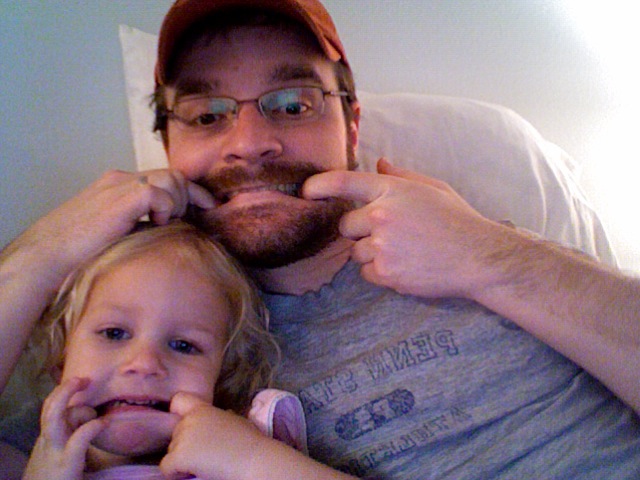
That time I grew a big beard

Back in September, we did something that I’m confident will grow into one of those “that time” stories in our family. You know, the kind of stories that start with, “Remember that time we…” and end with either some wonderful tale of adventure or the words, “man that was dumb.” I can’t yet tell you how this one will go – only that I’m confident it will occupy such a space in our family history. It will start like this…

Remember that time we bought that house that was almost as old as my parents.

And by that I don’t mean almost as old as my parents’ house. I mean almost as old as my parents.

To be fair, my parents are pretty young to be my parents. What I mean is they’ve usually been younger than most of my friends’ parents, and only recently have I noticed them doing things like this:

and shoplifting at the grocery store. Okay, so no shoplifting yet, but I assume it’s coming. Anyway, they’re still under 60, but like this house we bought, just barely.

We had lived in our previous house (that was way younger than me, much less my relatively-young-to-be-my-parents parents) for about four years, and we liked it very much. Mostly we liked that everything worked. We were comfortable and not particularly in a rush to go anywhere else. We also didn’t expect to live there forever, especially once we started adding more humans to our herd.

I’m still not sure what happened next. What I do know is that we and three other couples in our circle of weird friends all bought really old houses at roughly the same time – three of us within about a mile of each other. What has ensued for all of us was six months (and counting) of demolition and plumbing and painting and flooring and electrocution and new scars and cursing and a very loud sucking sound that is piles of money disappearing into the coffers of Lowes, Home Depot, and various beverage makers and marriage therapists.

That makes it all sound worse than it was. Well, no it doesn’t. But there are also many good things that have happened as a result of our move. We have trees – lots of them, and big enough to crush our whole house if one of them dies and falls. (We had only two crepe myrtles at our previous house, and one of them got ill and vomited goo all over our front sidewalk until my dad, brothers, and I ended its miserable tree life in a painful and gory episode involving inadequate tools for tree-cutting-down.) We have neighbors who actually speak to us. We live within a mile of five families who are a regular part of our life. We are now Bryanites. We have a lot more space than before, which is nice for all kinds of reasons: we can fit more kids, we can throw big parties, and we have a room on the far end of the house that’s almost-but-not-quite an apartment that allowed us to have Juliette join our household after she returned from Uganda.

Perhaps most importantly, this move will be remembered as that time I grew a big beard. See.

We spent about a week working on the house before we moved into it. We barely slept for several days, and I was lucky to get a shower at the end of each day. Shaving was not on my radar. Then we moved, and for two weeks I could not find my razor. By that point, I had a beard. My beautiful wife is not fond of the beard in general, but in the collective psychosis that followed the move, she said I could keep it a while. So I did.

Remember that time I grew a big beard?

Yeah, that was the same time we bought the house that was almost as old as your parents – the one that we raised our kids in and that never got crushed by a falling tree. Man, I’m so glad we did that.

That’s the hope, anyway.

Oh, and here’s some cuteness from the new place to offset the big beard:

By the way, that poor guy will keep falling up the escalator as long as you keep watching. And yes, I absolutely expect that posting that has earned me an equally magical moment at some point in my future.

I (still) do not like the Yankees

It is the rarest of moments that I throw my support behind a team from Philly in any fashion – and by rarest I mean only the Yankees can evoke such an unthinkable event. Nonetheless, it seems time for me to do my part to support the unraveling of the evil empire now that they've returned to the series for the first time since the original publication of my masterpiece.

I do not like the Yankees, Sam.
I do not like them, Thad I am.

I do not like them in the Bronx.
I do not like them o'er the Sox.
I do not like to see them win.
I do not like to see them grin.

If I should see them on the screen,
I'll call them something none too clean.
If I should see them on the street,
I'll spit and kick them in their seat.

I do not like the Yankees fans.
I do not like them in the stands.
I do not like them jumping 'round.
I'd rather see them gagged and bound.

If I should meet a Yankees fan,
I'd promptly kick him in his can.
If he should turn to kick me back.
I'd run like hell (I'm little, Jack.)

I do not like the Yankees, man.
I'm sick to death of that high priced clan.
They have a payroll six miles high,
And titles only cash can buy.

I will not give them any due,
I would not, could not give a poo.
I'll root (even) the Phillies on to win,
Damn Yankees must pay for their sin.

I do not like the Yankees, Sam.
I do not like them, Thad I am.

My life as an outsider: Searching for identity and survival in a Harry Potter world

If facebook stati are to be trusted as any kind of gauge of what people are thinking about, caring about, and actually doing, a significant number of people who have seen fit to befriend me there are into Harry Potter. Like, way into Harry Potter. It’s 1 a.m. and I’m about to go to bed. Many of them are less than an hour into the latest installment of the cinematic one-offs of these books. Some of them are dressed like wizards or witches or gremlins or something. In public.

I’ve read exactly 1/3 of the first book (years ago) and seen none of the movies, but I’m clearly becoming more and more marginalized in that respect.Harry Mouse

And that’s what occurred to me as I was preparing to eat a spoon of peanut butter (with a bit of honey) and drink some milk before bed: I think we may be reaching a cultural tipping point with Harry Potter.

I mean, at what point does this particular affection so saturate the culture that all of you Harry Potter weirdos become the normal people and the few of us who remain HP-agnostic/atheist types become the weirdos?

Maybe it’s already happened.

Now before all you Hogwarts dreamers try to turn me into a frog for calling you a weirdo, please note that I assigned no moral value to either normalcy or weirdness. Everybody’s weird in some way, and normal is overrated. I mean, I don’t get the costumes and magic wands and evil spells, but I’ve certainly got my own weird stuff.

Though, to be fair, none of it involves dressing up in costumes to go to movies.

Or posting “I’VE GOT MY TICKETS TO THE 12:17 SHOWING OF HALF-BREED PRINCE! OMG! I’M IN HEAVEN WITH HARRY! I LOVE HIM SO MUCH I’D MARRY HIM IF HE WASN’T A MADE UP BOY BELOW THE LEGAL AGE!!! LOL! ROFL! JK!” on facebook.

But seriously, please withhold your wrath. I’m not really making fun of you.

Well, I mean, I am, but I love you all. Mostly. And I don’t think there’s anything wrong with (most) of you. And I do think there are things wrong with me that forever disqualify me from any sort of classification of normal. Like, a lot of things. More things than you can shake your magic wand…too much?

What I’m saying is don’t get mad at me. I’m just lashing out because life is hard when you’re part of a misunderstood, marginalized group so unlike the rest of the population.

What if grace got to speak at Michael Jackson’s funeral?

Judging by the barrage of facebook stati (my made-up plural for status – we have to have words for these things if they're going to become part of our everyday lives), many of my friends (using the facebook definition) are tired of hearing about Michael Jackson. I think some were tired of hearing about him before they started hearing about him. I'm not really sure how that works.

I'm certainly sympathetic to the sentiment in most ways. I find our cultural obsession with celebrity exhausting and shameful. I've said before that if this whole show is still up and running in a few hundred years, I believe this will be one of the real condemning marks of our particular culture from a historical perspective. I think future earthlings will look at our infatuation with famous people in roughly the same way we look at the Germans' love of David Hasselhoff. Except it will be less funny and more tragic, helping to explain how we wound up in the Matrix or the Brave New World or something. (I was actually looking for an analogy a few hundred years in the past, but I grew impatient and decided the 'hoff was sufficient.)

I'm serious about this. I think we passed ridiculous about twenty five famous actress-and-her-boyfriend-fused-nicknames ago. We now not only deem it reasonable for people to be famous simply for being famous, we encourage it. We sit and watch people we've never heard of sift through a group of other people we've never heard of to find a mate. We call them by their first name when talking about them with friends as though they've done something noteworthy by dating and rejecting multiple partners on television. When I was in school, there were relatively unflattering names for people who did that. Now we call them The Bachelorette and build some small part of our lives around following them navigating a ritual we all hated when we went through it ourselves – dating.

I just alienated about three of the ten people reading this. Come back. This isn't really about those shows.

My point is this – I'm possibly too judgmental about our love of celebrities. I mean, I don't understand why anyone would read People magazine. See, it's bad.

I disclose all of that to tell you what an unlikely candidate I am to be interested in Michael Jackson and the response to his death (and preceding life). And yet I'm interested.

I'm sure some of it is nostalgia. I'm too young to have seen his early popularity in the Jackson 5, but I'm old enough to vividly recall him in the prime of his career in the 80's. He was, for a number of years, truly the king of pop – and this was before it was so absurdly uncool to listen to pop music. Shamone! Quite the opposite. I wasn't a rabid fan, but songs like Beat it, Billie Jean, and Thriller easily became part of the soundtrack of my childhood. But that's only a mild piece of my curiosity.

What he became and how we respond to what he became interests me far more than his music. It's easy to scoff at all his bizarre behavior – the butchering of his face, the altering of his skin color, the interactions with children that were, at best, inappropriate and, at worst, deviant and criminal. And I've heard and read plenty of scoffing. It's understandable. I scoff at famous people (and un-famous people) who are far more normal than this guy every day.

But for some annoying reason, the more scoffing I do and see and hear this week, the more this phrase rattles around in my head: We like grace when it's for us.

To be fair, on our good days we also like grace when it's for people like us and people we like. If we're the one whose sins are forgiven, we'll sing songs about it. Raise our hands. Start talking in religious language that most people around us don't understand. We get all geeked up when we can actualize that the miracle at the center of the Gospel – the relentless grace of God – is really for us. And well we should.

Every once in a while, we even realize that if we receive that kind of grace, we ought to be handing some of it out to others. But which others? Is grace just for people like us? Just for the minor offenders? Are child molesters and people who make us otherwise deeply uncomfortable out of luck?

I'm not asking if those people can get "saved." This isn't primarily an abstract question. I'm really asking – how do we decide who we scoff at and who we view with compassion and grace? I'm asking if the ethos of the Kingdom can tolerate unforgiveness of any kind. I'm asking, specifically, if people of the Way can feel okay about calling Michael Jackson names. I'm asking if life in the Spirit has space for our disgust, not for his actions, but for him as a person.

In the last several days, almost anyone I've seen try to go down this road has been bizarrely shouted down by Christians insisting that Michael Jackson is responsible for his own choices. That he chose his own bizarre existence and shouldn't be considered a victim when evaluating his sins. Fair enough.

But here's the thing we really can't get around: any of us who claim to believe the orthodox Christian Gospel simply cannot maintain that we are decent or moral or responsible because we got our crap together and, by God, made ourselves that way. We believe the Spirit of God actually transformed us and generated within us a new being – a new being whose nature we still fight against despite our claim to redemption. And if that's so, isn't this spirit of condemnation and disdain utter folly?

Hang on. Don't answer that yet. First let me tell you this. I'm not anti-judging. One of the poorest treatments of Scripture in (and out of) the church today is our free wheeling use of Jesus' words in Matthew about judging. Even people who are otherwise disinterested in Jesus like that he said: "Judge not lest you be judged." Only that's not all he said, and what we act like he meant doesn't appear to be what he really meant. Eugene Peterson elaborates that passage this way in The Message:

Don't pick on people, jump on their failures, criticize their faults—
unless, of course, you want the same treatment. That critical spirit
has a way of boomeranging. It's easy to see a smudge on your neighbor's
face and be oblivious to the ugly sneer on your own. Do you have the
nerve to say, 'Let me wash your face for you,' when your own face is
distorted by contempt? It's this whole traveling road-show mentality
all over again, playing a holier-than-thou part instead of just living
your part. Wipe that ugly sneer off your own face, and you might be fit
to offer a washcloth to your neighbor.

I think that's a fair rendering of what Jesus was communicating there, especially when read in the context of the rest of his recorded words. It is not a sin to judge. It is simply absurd to do it without expecting it in return, and, for the Christian, it's sinful to do it in a spirit other than the Spirit. So judge away. Just be sure you judge with the heart of the Supreme Judge, who sent his son into the world not to condemn it, but to save it.

Here's what I'm getting at. How we "treat" Michael Jackson, even from a distance, and even in his death, is not irrelevant to the Gospel. And whether or not Michael Jackson was converted is not all that matters when it comes to the Gospel's implications for this moment. The Gospel has something to say in his death either way. And it's going to say it through us.

Does it want to speak condemnation? Does it want to suggest that Michael Jackson was too weird for grace, in life or in death? Does it want to parade its ability to point out the obvious flaws? Does it want to diminish the cracked, sinful life as somehow less significant – less marked with the fingerprint of a creator – than other more "productive" lives?

I think the answer to those questions is found in discovering what the Gospel means for each of us. The Gospel – and indeed Jesus himself – demands that we be people of both justice and grace. Justice is a hard thing to execute on a man none of us knew. Even if he's guilty of all he's been accused of, there is little we can do but continue to affirm that such things are not reasonable behavior. Christians and non-Christians can agree on that. Children deserve our protection in every possible way. Shout that from the rooftops. Something got broken in Michael that skewed his gauges in this area, and there's no problem with that judgment being made. Talk about his love of money and his inability to relate to the real world. Those are tragic things. Say so.

But justice (of which making wise judgments is an essential part) is just half of the Gospel. The other half – grace – is just as real, and it's not just a matter of how grace gets from God to me (or you).

I've learned this from the many people in my life who have been victims of abuse of various kinds, including things worse than any allegation I've ever heard directed at Michael Jackson. These people have taught me that while justice is certainly important to their personal healing and wholeness, grace is at least as important. Their ability to extend true forgiveness to the people who harmed them has utterly destroyed my old conceptions of grace and the Gospel and replaced them with something that is exceedingly more beautiful.

I'm not talking about forgiveness offered begrudgingly or out of religious duty. I'm talking about the kind of grace that could look a child molester in the face and say, "I forgive you. You're free of this. Go live a real and full life."

That is utterly preposterous. Scandalous, even. Which is precisely the point. Grace is not rational.

So back to the questions. If grace were invited to speak at the Staples Center this morning, what would it say about the death of Michael Jackson? And, more to the point, what are we allowing it to say – or keeping it from saying – in the way we engage in a public conversation about his death and his life?

I think it would say that life is priceless. And that lives ruined and lost are tragic. I think it would say that God made Michael Jackson. And that God loves Michael Jackson. And I think it would say that, whether or not Michael ever managed to encounter this reality before he died, there is no one and nothing too weird, bizarre, or sinful for the grace of God expressed through Jesus.

I think the Gospel of grace wants to stand up and beat its chest to get our attention – to let us know that it can decimate any challenge to its ability to forgive. And then, just because that's what grace does, I think it wants to hug the vilest offender.

Me.

We are all looking for a resurrection

The resurrection of Jesus is the unraveling of the power of death in every sense. This moment in time has, in that way, become the pivot point of all history.

For the believer, it is the climax of our story; the overlap of heaven and earth; the power that fuels hope and love and life.

For the unbeliever, it is impossible. Men die. Dead men do not live again. It defies natural law, science and logic – and those things must always lead the way.

For all of us, it is the sort of thing that either is true or should be true. Someone ought to do something about all of the pain and loneliness and suffering scattered about. Someone ought to break into the realm of natural law, science and logic and do something about death. Few dispute this. These are, after all, the chief goals of not only religion, but medicine, psychology, biotechnology, and all manner of scientific and logical pursuits. More life. Less death.

We are all looking for a resurrection.

Our trouble

    "Where do you come from?" Pilate asked.
    But Jesus gave him no answer.
    So Pilate addressed him again.
    "Aren't you going to speak to me?" he said. "Don't you know that I have the authority to let you go, and the authority to crucify you?"
    "You couldn't have any authority at all over me," replied Jesus, "unless it was given to you from above. That's why the person who handed me over to you is guilty of greater sin."
    From that moment on, Pilate tried to let him go.
    But the Judaeans shouted at him.
    "If you let this fellow go," they said, "you are no friend of Caesar! Everyone who sets himself up as a king is speaking against Caesar!"
    So when Pilate heard them saying that, he brought Jesus out and sat down at the official judgment seat, called The Pavement (in Hebrew, 'Gabbatha'). It was the Preparation day of the Passover, and it was about midday.
    "Look," said Pilate, "here is your king!"
    "Take him away!" they shouted. "Take him away! Crucify him!"
    "Do you want me to crucify your king?" asked Pilate.
    "We have no king," the chief priests replied, "except Caesar!"
    Then he handed him over to them to be crucified.

-from John 19

From Tom Wright…

    When the Image of God appears in creation, the point is that the rest of creation will look at this Image and see their creator reflected. Now the son of God appears as the true Image of God, and the world is so corrupt in its rebellion that, rather than recognize the true creator God reflected in this Jesus, it must get rid of him, must blot out the reminder of who God really is, must do anything rather than be confronted by the one whose love will stop at nothing to reconcile creation to himself.

    And we who now stand at the foot of the cross have to face the most searching questions, the questions we avoid like the plague because we, too, find it desperately uncomfortable to look at the face of God's Image, the man, the king, and see there the perfect likeness of the maker and redeemer of the world. We are so stuck in the systems of Caesar — his swords, his coins, his gambling soldiers — that we too have a hard time recognizing truth of any kind, let alone speaking up for it. We are so anxious to protect the philosophies upon which our modern world is built that we will do anything to declare that we have no king but Caesar, that when push comes to shove religion is just a private thing which mustn't affect the public sphere, even when Jesus is reminding Caesar's representative that he only has power because God has given it to him. And perhaps that is one of the reasons why the church is in such pain at the moment, caught between "what is truth?" on the one hand and "no king but Caesar" on the other.

[From The Scriptures, the Cross & the Power of God.]

How do we follow a dead guy?

[I originally posted the following on Easter 2003 when we were still living in northeast Pennsylvania. Aiden, our oldest, was seven months old. The friend with whom I exchanged the included emails is now one of my best friends and co-pastors.]

It's Easter, and in a few hours Amy and I will put on our Easter best (or we'll put on clothes anyway) and go celebrate the resurrection of God's Son with other believers in our community at Parker Hill. That's a good thing to celebrate; the best thing, really. I just have this sense that many of us are only tuned into to half of the story. Some may think the following thoughts would have been more appropriate to post on Good Friday, and maybe that's true. Only they weren't written until very late on Friday (early Saturday, actually), so that wasn't possible and I don't feel like saving them for a year. Besides, I think it's about more than Friday or Sunday, or any particular time of year. Our faith isn't seasonal, or at least it shouldn't be. The Easter remembrance is an appropriate time for this sort of focus, but I think this has as much to do with who we are and what we believe as it does with how we feel one Friday a year.

A friend sent me an email at about 1 am on Saturday that included the following thought:

By this time 2000 years ago, Jesus had been dead for several hours, and the disciples were freaking out.

That image really resonated with me, and I replied this way:

Your reminder about what was happening 2000 years ago is deep and meaningful for me, which is how I'm sure you meant it. I've really been in that moment tonight more than ever before, and your brief reflection on it is all the more real after what we experienced earlier tonight. Our church had a communion service, and it was basically a funeral. I know some people use the descriptor "funeral" to disparage certain lifeless worship services, but that's not how I mean it. This was intentional and necessary. The mood was purposefully somber, and we were encouraged to begin quietly reflecting on the cross and Christ's death from the moment we entered the building.

One of our pastors began by opening a newspaper and reading excerpts from the obituaries. He said that reading about all those dead people didn't affect him much because he didn't really know them. The paper was from his hometown, so he recognized a couple of names, but none of them meant anything to him. Then he went back to the paper and read a woman's name with the same last name as him – his mother. He said this: "The effect Jesus' death has on us is proportional to the depth of our relationship with Him." Indeed. If we're able to breeze by Friday in the Easter weekend without being deeply affected by the cross and by Christ's death, it's like flipping through an obituary with names of people we don't really know. For the Christ follower, "Good Friday" should have the kind of effect it had on him [my pastor] to see his Mom's name listed among the dead. He insisted that we not move on to Sunday too soon; that we live in the reality of Jesus' death for the next two days.

The imagery of the funeral was very powerful to me tonight. As it relates to Jesus, we've all done the birthday parties, wedding, feasts, and resurrection celebration, but why haven't we ever done His funeral? The resurrection is ultimately what gives us life, but it's life from death. The resurrection required the crucifixion. Our obsession with the end game has obscured devastation and grief over the death of Christ so that we consider it sacrilege to ruminate on His death without tying it up with the happy ending. We didn't do that tonight. I don't believe there was any mention of the word "resurrection" except to encourage a regathering on Sunday for that celebration. Death was enough tonight, and it was okay to mourn. We left as quietly and as somber as we came. I think that's good. I think God is pleased for us to be grief-stricken over the death of His only Son.

And yeah, you're right about the disciples freaking out at this point 2000 years ago. I was reading in Matthew tonight trying to imagine what all of this was like for them. Jesus seemed to speak so matter of factly about what was going to happen in the days leading up to Passover, but I think those cats were clueless as to what was about to go down. Although we always get to make fun of Peter's foible in insisting that he'd never forsake Jesus, I was noticing the bandwagonish description of the rest of the disciples in that passage. Jesus tells them that they'll all fall away and be scattered like sheep, and Peter jumps out front and swears he'll die before he denies Him…"and all the disciples said the same thing too." These guys were either terrified or totally lost or both.

And I think your focus on their reaction a few hours after Jesus died goes to the heart of experiencing his death. We gloss over the reality of him being dead because we have this simultaneous propositional teaching that the resurrection came three short days later. For people living 2000 years after the fact, three days has absolutely no meaning. No big deal – he went down for a few days, then he was back on the scene and we're all good to go. I don't think we have even a marginal understanding of the fact that He didn't go to sleep for a few days…He wasn't in a coma…He wasn't laying low, hanging out in Joseph of Arimathea's luxurious rock cave drawing up organizational charts and strategic plans for the early Church on the walls until Sunday.

He was DEAD.

You had people who had given their entire lives to following Him (in ways that none of us can begin to relate to, really) who were suddenly left with a dead body.

How do we follow a dead guy?

He had told them He would be back, but it's clear they didn't know how to begin believing that in any tangible way.

My inability to comprehend what that was like is pathetic. I'm trying to get into that world and experience that loss with them, but I'm not even close. Amy has a friend from grad school who just found out about three months ago that his one-year old son had a rare, terminal form of cancer. This week, only ten weeks after the diagnosis, he died. We found out yesterday, and it was pretty emotional because it's so personal to imagine watching our baby die. Thinking about the pain and loss they must be feeling literally makes me ache to my bones, and I don't even know them and can't begin to taste the depth of their suffering. It's as bad as anything I can imagine. As I think on the death of Christ, that's what I'm thinking about. This is something that we need to feel more deeply, I think.

A letter to a friend

Dear Julio,

Please make your plastic salsa containers easier to open. My fingers are bleeding.

Warmest regards,
your friend Thad

P.S. I usually prefer to eat the hot salsa, but sometimes better judgment leads me to cut it with a bit of mild to spare my innards. Perhaps you could consider a medium version for gringos like me who have a taste for spicy paired with dubious digestive tolerance. Many thanks.

Hotsalsa

The Reason

I don't do this often (and by "this" I obviously mean link to someone else's blog or post on my own blog), but you should go read this short little bit of goodness right now. It's a post by Andy Osenga, a singer-songwriter type who I like a lot (and by "like" I obviously mean I admire his words and work, not that I want to date him). What he's written is a challenge to me. If you're not a musician, and I'm not (unless by "musician" I mean someone who really likes music but isn't musical, and I obviously don't), don't lose interest because he starts by talking about making an album. The ensuing wisdom is universal in its application.