Am I your friend? Musings on social media and discernment

Last night I posted the following facebook status:

I just almost friended someone I haven’t seen in over a dozen years. Then I read some of his page and realized I don’t have the space in my (social media) life for his current level of cynicism. Then I realized what it was like to encounter me a dozen years ago and wondered what friends I might have now if I hadn’t been such a knucklehead.

Sorry, everybody. You can friend me now. I’m still a knucklehead and occasionally cynical, but I think it’s much more tolerable than it used to be.

At the time I posted it, I mostly was having a light-but-serious moment of introspection, both about how I judge other people now (which I do everyday – I’m a dirty judging sinner, but you aren’t, so don’t you dare judge me for being one) and about who I was and how I came across to others in another season of my life. By no means did I mean to imply that I’m free of the flaws and vices that entangled me back then or that I’m Captain Warmth N. Hospitality these days. I’m just self-aware enough to know that, by God’s grace and with much loving assistance from many people, most regularly the extraordinary woman and three little humans in my home, I’m not quite as abrasive and oozing angst as I was at various points in my history.

How we look to aliens

How we look to aliens

So all of that was swirling in my head as I posted. In the background was an inner dialogue I’ve been having for years, but at amplified volume in recent months, about the real estate social media occupies in my life. In short order, one or two of the comments on my status tapped into that subterranean well of not-quite-coherent and woefully incomplete thoughts. I began to engage those comments with one of my own, then realized I was starting my seventh or eighth paragraph…in a facebook comment. Of course this is not unprecedented for me, but this time it seemed to make more sense to mutate that comment into something more – in length, at least, whether in substance remains to be seen. So here goes.

I tend to believe social media is like almost any other “it” (non-living entity) in that it is value-neutral; it is not inherently good or bad. However, I think like all “its,” social media is riddled with potential snares. There’s no question that what someone has highlighted in these comments — the temptation to flippantly judge people’s lives and even “delete” them from ours based on what they post on social media — is one of those snares. Before I address that in particular, let me try to better explain my current struggle to discern the proper place for and use of social media in my life.

I believe the snares of this particular “it” are multiplied and amplified by the staggering pace of social media’s emergence and the blinding speed at which it grows and changes. Most of us have gone from having little to no awareness of social media to allocating large chunks of space in our lives to it in a matter of only a few years.

We all know people who give many hours of attention every day to social media – attention that a few years ago was directed at something or someone else, often actual work or people in their physical presence. We’ve all experienced “quality time” in a meeting or at lunch or in our living room with someone whose attention was at least as devoted to a 4×2 plastic rectangle as to us or the other humans in the room with them. And many of us have been those people. I have.

I’ve also watched people I never would have imagined doing so begin to almost arrange parts of their lives either around their time on social media or around how they will convey the details of their day, both major and superfluous, to their “friends” and “followers,” sometimes including hundreds (or thousands) of people they never will meet.

However innocuous it may seem, there is a transaction taking place in these moments and habits; we are investing some portion (usually larger than we realize, I suspect) of our time, attention, and possibly identity in a public representation of ourselves to people who are often removed from our lived-in-real-time-and-space lives by several degrees – a portion that inevitably cannot be invested in moments and with people who are, you know, in the room with us. We are finite. Every investment has an equal and opposite divestment.

I am not trying to make an indiscriminate run at people who like these things more than I do. I’m incredibly flawed and prone to error in all of this.

Wherever our habits or preferences, this is undeniable: as social media has exploded, we who interact with it have changed. And we have changed very, very quickly. Most historians, sociologists, physicians, psychologists, poets, and pastors will tell you that so much change so fast with so little reflection or discernment is almost always unwise. Unfortunately, many of our historians, sociologists, physicians, psychologists, poets, and pastors have so inculcated these particular changes that they do not have the time, inclination, or insight to prophetically warn us, “Hey dummies, slow down and take inventory of your lives and how you want them to be spent when you reflect on them in 30 or 60 years.” I am wrestling with my own culpability in the abdication of that responsibility.

This discussion of social media, of course, is a subset of the way we have come to engage with the internet (which is a subset of a subset of other conversations), but it is a unique one in that it is so personal. We use “friend” and “defriend” as replacement verbs for “clicking a button on a screen.” We become “followers” of other people and accumulate our own “followers.” Some of us work very hard to grow our number of followers and, I’m convinced, get lured into the most obvious and literal evils of such an endeavor. We evaluate the events of people’s lives from thousands of miles away without ever having to look them in the eye. We have fights we never would have had without these tools (and by “tools” I mean social media outlets, not the people with whom we are fighting). We capture the most tender moments of our days, edit them with sophisticated photo software to make them look as appealing as possible, then seconds after they happen, share them with the world.

Again, this is not all inherently bad, but it is a strange mix of personal and public that, a decade ago, most of us not only could not have imagined, but also would have thought was a bit weird.

Maybe I’m old, but it all still weirds me out a little. Yet here I am with active accounts on three major social media outlets, not to mention my own website and the ubiquitous-among-Aggies TexAgs.com. And what I’ve realized is that, as leery as I am, I’m still prone to being deceived and distracted by it all in ways that aren’t altogether healthy.

My life apart from social media is full of real people, real problems, and real joys. Seven or eight years ago, the real people, real problems, and real joys in my regular life were pretty much the whole of it. More recently, I’ve realized that even as I passively read the news feed on facebook or scan twitter or instagram, the people, problems, and joys of the people I encounter there are beginning to occupy internal space that used to house only a fraction of all of that.
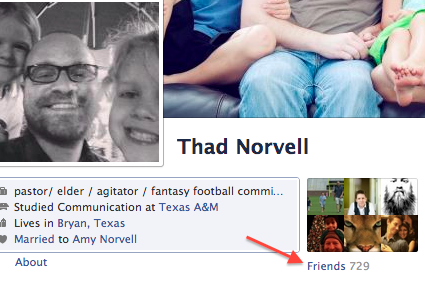
Look how popular the facebook lets me pretend to be!

Look how popular the facebook lets me pretend to be!

I mean, at this moment I have 729 facebook friends. That’s silly – so silly that I’m including a photo just to prove it’s true. There is no way that many people actually like me, and I certainly can’t maintain that many real friendships. I struggle to maintain 10-20 with the people closest to me. And yet because all 730 of us have entered this social media contract to be “friends,” I feel a subconscious emotional pull to allow space in my life for whatever piece of their lives they happen to type in a box on a screen or photograph with their phone. Even when I scoff and dismiss people for what they post (again, because I’m a dirty judging sinner), I still give time and energy to them and to their words and feelings. It still buys up one little piece of my day and my mind.

That’s not all bad. Even on facebook, I’ve had some amazing reconnections and interactions with people I otherwise never would have talked to again about some very important things. I’m nostalgic and idealistic in ways that would surprise many given my external affect, and, at least internally, I’m painfully loyal. But I’ve also begun to passively assume that I have some sort of obligation to a lot of people who aren’t in my life aside from social media and, more to the point, a lot more people, problems, and joys than I have capacity.

Everyone has to decide for him/herself how to manage that, but for me it has meant exercising more discernment in how wide my social media net grows. Honestly, the easiest part of that is the kind of decision that inspired my original facebook status, choosing not to initiate a social media “friendship.” This was just one example of that I chose to describe publicly because it was a humbling moment that taught me something about myself. To be fair, my compulsion to share that with 729 people may merit some lengthy examination.

Often what transpires as I make these decisions is not nearly that deep, and it seldom has any more to do with the person I choose not to “friend” than acknowledging to myself that they either a) aren’t someone I actually was a friend to when we knew one another twenty years ago, and/or b) aren’t somehow meaningfully connected to me or the group of people I feel called to be engaged with in this season of life. Obviously the second of those criteria is highly subjective, but as much as I’d like to believe otherwise, I’m a highly subjective creature.

The more challenging decisions come in other areas: responding to requests from people who don’t generally fit either of those criteria, occasionally having to decide how much energy to invest in an online interaction that matters a lot more to someone else than it does to me, and the like. What will be to some my darkest confession here is that I have hidden a fair number of people from my feed over time. I haven’t “defriended” many, but I have hidden more than a few.

Of course I don’t want to be a jerk or hurt anyone’s feelings, but the truth is actually quite simple: I can’t do it all, even passively. I can’t absorb slivers of the lives of 729 people while still tending well to the people I encounter face-to-face every day and every week. I can do some of them, but not all of them.

So my choice has been to either abandon social media altogether (or at least certain outlets) or exercise discernment in how I use it. For now I’ve opted for the latter, but the former is never off the table. Obviously part of that discernment is simply self-discipline, particularly choosing to use my time well and to be present when I’m actually with people. Yet even when I engage wisely and sparingly, I sometimes am overwhelmed by the lives and thoughts and feelings of people with whom I otherwise have no relationship and who post without me and my response in mind. I’ve concluded it’s not a sin or unfriendly for me to choose not to take in some of that (hence the hiding and such).

I hope always to be ready to respond graciously and sincerely to any direct interactions with people and to moments and situations where it’s clear I’m supposed to engage despite having no logical reason to do so. Some of the best and most important moments of my life would have been missed if I blindly applied the criteria above to every possible interaction, so I have no desire to operate that way. I’m even prone to initiate some of those interactions, which means I’m occasionally on the receiving end of someone else not reciprocating my interest. And that’s okay. I’m just trying to exercise discernment and wisely apportion my time, my energy, my mind, and my heart. I don’t assume others will reach the same conclusions as they discern these things themselves. We’re all wired differently and called differently. And thank God for that.

If there is an overriding value that I hope we can collectively embrace, whatever role we ultimately give social media, it is presence. As a natural introvert who loves quiet time alone, this is a lifelong lesson for me, and my heart is often ahead of my reality. Yet I’m utterly convinced that our presence with one another – physical, mental, emotional, and spiritual – is essential to our humanness; to our living.

May we all be present and live.

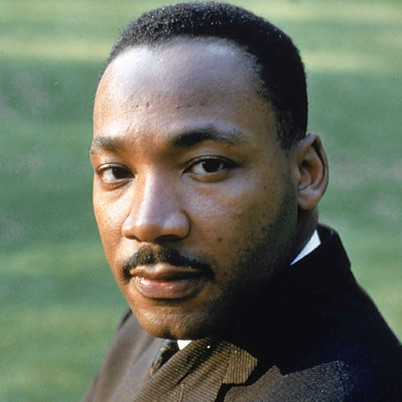
Martin Luther King, Jr.: one white man’s gratitude

When I was in fifth grade, I had a classmate named C.L. Armstrong. C.L. was black, and even back then, I was not. I have my share of prejudices, but I will say this on behalf of ten year-old Thad: he did not understand why anyone cared about the color of someone else’s skin.

This was not a virtue of my own making, nor was it a function of an ignorance that some people did, in fact, care. Dozens of times I had heard the n-word from one of my great grandfathers, who was born in 1889 and lived through my freshman year in college. This man would have been as at home as a barely believable character in a classic southern novel as he was in the real world. I don’t recall him ever referring to me, my brothers, and our cousins as anything other than “my little jackasses,” always in a roaring guttural voice that echoed for a half mile, the result of him being almost totally deaf from working in saw mills when he was young (before, apparently, anyone thought stuffing something in your ears might be a good idea).

He was a man who was deeply flawed beyond his vocabulary, but he was sort of a mythic figure in our lives simply for living so damn long, never mind the fact that he abused his body for a century, drinking copious amounts of hard liquor for decades, using tobacco from his childhood (and regularly offering it to his little jackasses), and daily eating exactly what experts will now guarantee to kill you by 40. He died a few months shy of his 105th birthday because, while in the hospital for an infection in his toe, he successfully physically resisted an army of hospital staff trying to put a feeding tube in him, then decided he was done and quit eating. I’m not kidding.

Anyway, my point is neither to demonize nor lionize him. He was wrong about race, but my heritage – and yours – is littered with saints and sinners, most of them mixed up in the same bodies. Papaw Jim probably leaned more toward the latter, but I certainly don’t mean to suggest that he was my only connection to racism. I mention him to note that in 1986, I had a living link to racial attitudes of someone born less than 25 years after Lincoln was killed. That covers a lot of dark history in this country.

And yet, while not unaware that race seemed to matter to some, I did not understand why. Although my boldest move – integrating the boom-chicka-boom circle on the playground – wouldn’t come until the following year (yes, that really happened), one January day in 1986, C.L. came to class wearing a bright orange t-shirt screen-printed with a black man’s face and some words. (Only today, upon finding the very same shirt online, did it dawn on me that this happened on the first nationally recognized Martin Luther King Day.) I was vaguely aware of Martin Luther King by then, but I was ignorant enough both of his legacy and of the need to be embarrassed by how little I knew about him to simply ask C.L., “Why are you wearing that shirt?”

This is exactly the shirt C.L. wore that day.

This is exactly the shirt C.L. wore that day. As I searched for a picture of it, I found an ebay listing for the exact shirt (vintage, not a replica) in my size. I now own it.

I don’t remember exactly what he said. I wish I did. I just know I suddenly became aware of three things: this thing between white people and black people has been messed up for a long time, C.L. seems more affected by that than I am, and I want to know more about this Martin Luther King. Soon after, I found a book about him in the school library and read it for a monthly book report. That began what has grown into a deep fascination with and appreciation for Dr. King and the struggle of so many who labored before, with, and after him to return us to not merely a more perfect union, but a more perfect humanity – a way of being human that is more reconciled to who we were created to be.

As I watch Martin Luther King Jr.: More than a Dream tonight, as I wandered into our local Martin Luther King Day rally too late to hear the speakers but just in time to be the only white man in the house (there were others who had already left, but I suspect far too few), and as I’ve read the numerous King quotes posted on social media today, I’ve had two persistent thoughts. The first is that I see more of my white friends embracing and, I think, understanding Dr. King and his words every year at this time, a phenomenon I can’t help but think demonstrates both real progress in the struggle and the opportunity for many of us to understand and engage lingering issues of race more deeply and more often than once every January.

And I mean us, not you. I have studied Dr. King and the movement more than your average white guy, but I am not an enlightened beacon of racial progress. Our political culture continues to poison the well of human dignity and understanding, and we must do more and give more and be more to resist the resulting cancer.

The second thought is this: as I have said about Rich Mullins, Martin Luther King, Jr. is one of the handful of people who I never actually knew but who I deeply miss. He died seven years, two months, and nine days before I was born, but I miss him. And I think we all miss him, whether we know it or not. He was uncommon in his vision for who we all were created to be and his ability to give everyone in the room eyes for that same vision. God, send us more folks like that.

So I am grateful that, even though his life was cut short as a sacrifice for many others, his words and legacy endure. I am grateful on so many levels…

As a writer and a preacher, I am grateful that Dr. King left us with timeless words whose skillful arrangement is matched only by the spirit of grace and penetrating truth that permeates them. He reminds me that writing and preaching matters. He reminds me that writing and preaching well matters. But mostly he reminds me that those things matter most when infused with a spirit that enables words to call into being realities previously unarticulated, maybe unimagined. If I ever write or preach again, may it be for that purpose. Do yourself a favor and read his Letter from a Birmingham Jail, and thank God for the written word and for Martin Luther King, the writer. Watch his final sermon, given the night before he died, and thank God for prophetic men like Rev. King, who give their lives to speak the truth.

As a pastor and leader, I am grateful that Dr. King, in his own words, was not worried about longevity of life or his own well-being, but gave himself fully to God’s will for those he led. I am grateful that he was brave enough to go up to the mountaintop to see the promised land, knowing he might not get there himself. He reminds me that without courage, we shrink back from the bigger vision, fearful that seeing it without guarantees might be too much. His audacious, selfless faith inspires me to pray for the kind of courage required to see the promised land.

As a father, I am grateful that Dr. King dared to dream of a world where my children, if they live to be 105, won’t recall a day of their lives when their closest friends didn’t include people of varying shades and hues. If I could speak a word to Dr. King today, I would tell him that we grownups have many miles to go to see his dream realized in its fullness, and then, daddy to daddy, I would say this: “But your dream is fulfilled, fully, in our children.” God, grant that we would faithfully tend their innocence and purity, empowering them to be lifelong ambassadors of the dream.

Finally, as a Christian and a man, I am grateful that Martin, the Christian and the man, was imperfect. While he certainly was a hero, he was no superhero. He struggled with the brokenness, temptation, and sin that plague all men. He was not other. He was a man, ruined by God to follow Jesus through death, convinced that was the way to resurrection. He was right, and bless God for the grace that enables a flawed man to lead so many others – even generations who will come after him – to take that same journey. He reminds us all that life and liberty are a gift of God’s grace to us, and that no man, including ourselves, has the right or the power to deny us that grace or that gift.

Let freedom ring!

Martin-Luther-King-Jr-9365086-2-402

Why I believe in Jesus when children are murdered

Gather ’round, ye children, come
Listen to the old, old story
Of the pow’r of Death undone
By an infant born of glory
Son of God, Son of Man

Those are the opening words of Andrew Peterson’s Behold the Lamb of God, a series of twelve songs that tell the story of a baby saving us all from death. It’s a ridiculous notion by most standards, I know. And I don’t just mean the part where a God we can’t see is involved in our lives or the part where he actually shows up in our world in the form of a baby or the part where he somehow dies and rises again to save us all from our sins.

I mean the notion that death has been undone. It seems silly. Impossible. And of all days, today it seems utterly contrary to what our bloodshot, tear-filled eyes see on television. There simply is nothing about the mass murder of school children and the hearts of parents split wide open that would cause anyone to suspect that death is undone. Whether the battle is spiritual, physical, cultural, or political, Death seems to be carving out new spaces in the world. We spend decades and billions of dollars chasing it down through vaccines and the eradication of diseases that plagued humanity for centuries, and suddenly it moves into our elementary schools as if to mock us. No matter who you are or what you believe, this much is undeniable: Death is a persistent, heartless bastard.

Today is the kind of day that causes the most devout of (honest) Christians to look to the sky puzzled and shattered, wondering why. This is the kind of hellish suffering that places a seal over the hearts and minds of skeptics and unbelievers everywhere. And on days like today, the most devout of (honest) Christians understand why. If a merciful God exists and is involved in the universe at all, children shouldn’t be murdered.

I confess I spent a number of years dealing with death mostly in theory and from a distance. This year has robbed me of the option to speak about death and its undoing in abstracts. I’ve pastored three families grieving the loss of their father, sister, and daughter, including the families of two of my best friends – families I consider my own family. I’ve stood behind a microphone at three funerals. I’ve walked with Amy as she mourned the loss of one of her close friends, a 39 year-old mother of two young boys. I’ve cried at least once a week for four-and-a-half months when I look at my kids, still deeply connected to the moments when death came for one of ours (and lost).

There is no religious pretense left in me when I speak of death. I know it is real. I know it is cruel.

So how do I believe in Jesus on a day like today? How can I still imagine that a loving, invisible God is alive and at work in a world where children and adults trying to protect them are arbitrarily slaughtered?

Because I must.

I must believe that Death won’t be allowed to continue to eviscerate us. I must believe that better drugs and better laws are not our only weapons. I must believe that there is a greater victory coming than safer schools or fewer guns. I must believe that there is a gentle Maker who is tending to the souls of lost children. I must believe there is a Righteous King who will deal justly with Evil. I must believe that there is a Rescuer who will make everything sad become untrue.

I cannot believe that life and death are arbitrary – that each child’s murder will be the end of her story – that each shattered parent will be left without hope of a day when their every moment isn’t defined by unspeakable loss.

Life can’t be a story in which Tragedy and Evil and Death have the final word. There must be another chapter. And there must be a Hero.

Certainly there are other reasons for my faith, and there will be other days for describing them. Today is for this one: I believe in Jesus because I need a rescuing hero. I need to know that Violence and Death – however much they try to steal and kill and destroy – will not have the last word. I need to know that Love and Life win, and I refuse to believe they don’t.

I believe in Jesus today because deep down in my soul, I believe Death will be undone, and the Story of Jesus putting Death itself to death is the best story I’ve ever heard. My soul says it must be true. Nothing else will do.

After the last tear falls
After the last secret’s told
After the last bullet tears through flesh and bone
After the last child starves
And the last girl walks the boulevard
After the last year that’s just too hard

There is love
Love, love, love
There is love
Love, love, love
There is love

After the last disgrace
After the last lie to save some face
After the last brutal jab from a poison tongue
After the last dirty politician
After the last meal down at the mission
After the last lonely night in prison

There is love
Love, love, love
There is love
Love, love, love
There is love

And in the end, the end is
Oceans and oceans
Of love and love again
We’ll see how the tears that have fallen
Were caught in the palms
Of the Giver of love and the Lover of all
And we’ll look back on these tears as old tales

‘Cause after the last plan fails
After the last siren wails
After the last young husband sails off to join the war
After the last “this marriage is over”
After the last young girl’s innocence is stolen
After the last years of silence that won’t let a heart open

There is love
Love, love, love
There is love

And in the end, the end is
Oceans and oceans
Of love and love again
We’ll see how the tears that have fallen
Were caught in the palms
Of the Giver of love and the Lover of all
And we’ll look back on these tears as old tales

‘Cause after the last tear falls
There is love

(After the Last Tear Falls by Andrew Peterson and Andrew Osenga)

And then there was no party of peace

This is an important piece by a fellow named Glenn Greenwald, who Google tells me is a well-educated man who writes about politics. Here is the gist of it:

For the last four years, Barack Obama has not only asserted, but aggressively exercised, the power to target for execution anyone he wants, including US citizens, anywhere in the world. He has vigorously resisted not only legal limits on this assassination power, but even efforts to bring some minimal transparency to the execution orders he issues.

This claimed power has resulted in four straight years of air bombings in multiple Muslim countries in which no war has been declared – using drones, cruise missiles and cluster bombs – ending the lives of more than 2,500 people, almost always far away from any actual battlefield. They are typically targeted while riding in cars, at work, at home, and while even rescuing or attending funerals for others whom Obama has targeted. A substantial portion of those whom he has killed – at the very least – have been civilians, including dozens of children.

Worse still, his administration has worked to ensure that this power is subject to the fewest constraints possible. This was accomplished first by advocating the vague, sweeping Bush/Cheney interpretation of the 2001 Authorization to Use Military Force (AUMF) – whereby the President can target not only the groups which perpetrated the 9/11 attack (as the AUMF provides) but also those he claims are “associated” which such groups, and can target not only members of such groups (as the AUMF states) but also individuals he claims provide “substantial support” to those groups. Obama then entrenched these broad theories by signing into law the 2011 National Defense Authorization Act, which permanently codified those Bush/Cheney interpretation of these war powers.

To be clear, the headline and the partisan sniping in Greenwald’s piece aren’t why I think it is important. I am largely unaffected by those elements since we’re talking about a president riffing on and tailoring powers invented by the previous administration.

What does affect me is the U.S. government’s ever-escalating reliance on violence in general and killing from a distance in particular as a preferred means of “solving” problems. The discussion of party only matters to me because it clarifies what I believe strongly: neither party has the moral high ground on this issue.

I mention this because as I watch many around me gravitate toward progressivism and, most often, Democratic candidates in a sincere effort to find a kinder, gentler political home, I observe an alarming lack of nuance in acknowledging or understanding what Greenwald describes: that the Obama administration has hardly been dovish.

I mention this because as I watch many around me continue to link arms with Republican candidates because of their heartfelt passion for protecting and preserving human life, I’m stunned at how little real conversation there is (to offer one example) about the 150,000 civilian deaths in two wars started by a Republican administration.

I’m not after a debate about the virtues or lack thereof of either party, and I’m sincerely asking that the focus of any comments be on the remainder of my words, not on defending the side you identify with most closely. I understand most who have chosen a side in some fashion are quite persuaded of their choice, and it is not my goal to dissuade you. I mention parties only to explain that I observe our government and much of the country – inclusive of both parties – to now accept, some more actively than others, a way of violence that I personally do not accept. I wish to poke at that – not at the parties themselves.

Image

Perhaps this is all about saving money on windshields?

I am of the scandalously unAmerican opinion that much of what we call technological progress has made killing so convenient that it almost demands we make “good” use of it. We are led by the machinery as it offers ever-simpler, cleaner solutions to our human dilemmas. It is not surprising, then, that political and legal lines will be redrawn to rationalize this lack of principle. It would all be very handy if the price – our collective soul – wasn’t so steep. The charade of moral superiority in the world has a limited lifespan, and we aren’t too many drones away from finding out what it is.

I’ve not made a secret of my very limited expectation of any human government, even the most well-intentioned. Yet even I have hope that we might at some point demand that our leaders – who are elected under the guise of defending “liberty and justice for all” – rediscover enough conscience and humanity to put a stop to this foolish downward spiral. We cannot win by matching evil-doers blow for blow, however tempting or satisfying that might seem. Somehow, some way, some day, we must find the soul to believe that evil can be overcome only by good and muster the imagination and courage to invest ourselves in that endeavor.

(Still) a good day to die

I’m always aware when September 19 rolls around. It’s the date that both my grandmother and Rich Mullins died – Mamaw seven years ago, Rich fifteen years ago. It’s also three days after September 16, the date my grandfather died and that Amy’s dad was born. Papaw died thirty years ago, and Tom would have been 74 this year (he died in 2001). For lots of reasons, I’ve thought about all of them a bit more this year. I wrote some about my developing relationship with death, but I’m too tired to finish those thoughts in a coherent way. Soon. Until then, below is a rerun of what I wrote about death, Mamaw, and Rich seven years ago. I also wrote some about these things a couple of years ago here.

A good day to die

Eight years ago, back in my single metrosexual almost-North Dallas days (I don’t really know what metrosexual means, but it makes my early 20s sound more exciting, don’t you think?), I got some sad news. My friend Brad and I walked into his apartment and were greeted by a message from Brad’s roommate, a big red-headed guy named Pape (which is illogically pronounced “Poppy”). Scrawled barely legibly on a scrap of paper was this note:

your dad called – rich mullins died

Both the news itself and something about its delivery were startling to me. Why would God let Rich Mullins of all people die now and why am I finding out from a stupid note like this? Silly questions, of course, but those were my initial reactions. Strangely, though I don’t remember doing it, I apparently stole the note and kept it (sorry, Brad). I only know this because I ran across it as I was shuffling through a box of miscellaneous evidence of my pack-rattery during one of our recent moves. If I had a little more energy, I would dig around for it and scan it instead of retyping the note above. The possibility that it’s in one of the 22 boxes still stacked in our garage just barely persuades me that such an effort is completely unnecessary.

Anyway, as I think I’ve said somewhere before, Rich is one of the only people I never knew who I genuinely feel like I miss. One of my first blog posts ever alluded to this. It’s okay if you think I’m weird. I just listen to him sing and read his words and feel like he knows me better than a lot of people who actually know me. I feel like he knows life the way I know life; knows Jesus the way I know Jesus; knows failure and ache the way I know failure and ache. I think lots of different people who live very different lives feel that way about the guy, and I think that says something meaningful about the residue of his life (a phrase he’d probably like).

My point here is not to gush endlessly about Rich. I’m not writing about Rich and the day he died because Monday marked eight years since he crossed over. Not really. I’m writing about him and the day he died because Monday, eight years after Rich died, I held my grandmother’s (Mamaw to all of us) hand as she made her own crossing. After a long life in this realm that we see and smell and touch and hear and taste, her lungs quit breathing and her soul slowly vacated the broken-down body it had inhabited for nearly 93 years. My cousins David and Jesse were also at her bedside, and Amy and David’s wife Linda stood behind us as we did what we could to help escort Mamaw from here to There.

AT MamawI don’t really know what those moments were like for Mamaw. She was still and peaceful – obviously more comfortable than she’d been in the days (years, really) prior. She didn’t speak to us or acknowledge our presence in ways that we could see or hear. That had ceased the night before, when several of us had spent time with her before the medications sustaining her body were pulled back. In moments Amy, my Aunt Molly, and I will never forget, Aiden sat on a stool by Mamaw’s bed and poured three year-old tenderness all over her. Writing about it would fail to convey the ways in which his reassuring words, soft hands, and sweet smiles created life all around a dying woman.
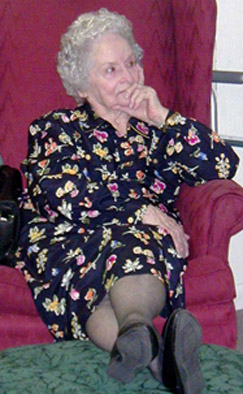

But Monday morning was quiet. We touched her and spoke to her in whispers. Though she didn’t physically respond, I sense she was more alive than ever, as the her that was slowly became the “new her” with each fading breath. She wasn’t gone, and the shriveled shell on the bed didn’t define her. It never really did; it just appeared to. Dying just sealed the deal, finally divorcing her eternal identity from the physical confines of flesh and bone (and arthritis).

Mamaw was ready for this, and she had been for some time. In some ways she’d been ready since that day in 1982 when Papaw went on ahead of her. Most days her readiness was dignified and patient, tempered by her love for all of us and her faith in God’s curious wisdom. Other days it was less steady, driven by the frustration of pain and immobility or a deep ache to be with her Cecil. I understand and love her for both. She was faithful and sure; she was tired and fragile. I’m 63 years behind her in this journey, and I get all of that.

But I don’t think she was the only one who was ready. Tonight I talked with my cousin David, and he described a keen awareness in those final moments of Papaw waiting for her, pleased as punch that the three grandsons who could get there were by her side. David didn’t see a ghost or hear any voices; he just knew Papaw, and he knows Papaw was on hand for the big event. I wonder if we are too inclined to discount ideas like that, maybe because we’re skeptical of what we can’t see and maybe because years of powerless religion have convinced us that all the supernatural stuff happened a long time ago.

They tell us a “cloud of witnesses” continually surrounds us, apparently looking on with anticipation as we run the race marked out for us. This moment was the end of Mamaw’s race, but it was a meaningful bend in the course for the rest of us. I think David is right. I think Papaw is in that cloud — he’s probably the designated cloud farmer and janitor — and I think he’s ecstatic to have Estelle join him in keeping an eye on us. I know she is thrilled beyond all imagination to finally be with Cecil and Jesus.

Tonight I was struck by the realization that Mamaw and Rich left us on the same date. It may seem insignificant to everyone else – old folks die and famous musicians seem to have a strange and disproportionate tendency toward fatal accidents. I don’t theorize that there is some deep, divine meaning in the coincidence. I mean, these people never heard of one another. Rich smoked and cursed. Mamaw was a true, old school Southern Baptist who shocked the world when, in her last weeks as her health deteriorated, she answered a group of church folks visiting her in the hospital who asked if they could pray with her with an emphatic, “Hell yes.”

There seems to be no connection between the two but the day they died. Well, that and this: they loved a guy named Jesus desperately, and they lived their lives to follow him as best they knew how. Neither had it all right, this living as a Christian. Rich probably loved his liberty (and nicotine) too much at times. Mamaw may have been a bit too committed to certain religious traditions (like being Southern Baptist). They were both humanly flawed and incomplete. They were both heroically devoted and faithful.

So, strange as it may seem, I wonder if Rich was in that cloud that greeted Mamaw on Monday. Maybe it was his eighth birthday party and he wished for a widow to be rescued into eternity. Maybe Papaw caught him smoking in his corn field and promised not to rat him out if he’d make that wish. And maybe those wishes really come true on the other side. Who knows why September 19 is such a good day to die, but it’s two-for-two in my book.

Whatever the story, Mamaw is home — with a chain smoking vagrant named Rich, a jolly Texas logger and farmer named Cecil, and that guy named Jesus who she followed to the end.

Mamaw, I’m glad you finally made it, and it was an honor to sit next to you on your way out. Oh, and if you’re “looking on,” go easy on the ones like Rich. I know they seem like ruffians, and maybe you never expected to see them up there, but don’t lobby to get the rules changed or anything. Some of your grand-kids are taking the same route those hoodlums took. We weren’t allowed to tell you that before, but all those secrets are history now, aren’t they?

Mamaw2_1

Estelle Belle Geldard Hatton
1912 – 2005

A happy ending to a tragedy or a tragic beginning to a blessing?

This is the completely unanswerable question that Amy and I – and in their own ways our three kids – have been unable to escape for the last two days. It’s likely to sit with us for a while.

Before explaining, let me show you something that will melt your soul. This is our youngest, Ainsley Kate, two months shy of five years old.

My sweetest surprise

That stunning beauty is inexplicably half me, genetically speaking. I call her my sweetest surprise and have since I first met her. I explained why in a post I wrote with her on my lap when she was five months old (feel free to read that post, though I can’t go back and read it just yet). We didn’t know we were getting her until she was formed, which is to say we didn’t make plans to conceive her quite like we did her older brother and sister. She was a surprise, and she’s proven to be an even sweeter surprise than I knew almost five years ago.

I’m showing you this picture with her coy little smile to tell you that, although the photo itself was taken weeks ago, I’ve seen that smile – and even a few bigger – several times since Tuesday. The photo is a blog version of the phone call from a family member that begins, “She’s completely fine now, but…”

But on Tuesday we almost lost her. Like really lost her.

There was no prolonged illness. No crashing cars. No gunfire. It was silence that almost took her. Silence created by the most ordinary of events: lunch.

Sitting at the table with her friends, Ainsley was doing what four year-old kids do: she was trying to squeeze a bunch of grapes into her mouth. She realized she’d over done it and couldn’t swallow, and she spit a pile of chewed up grapes onto the table. And then, somehow, one of the grapes that had completely evaded her teeth escaped and lodged itself in her windpipe. Initially as she struggled, her friends and Amy (who hadn’t seen the mouthful of grapes) thought she was ill and about to throw up. Amy then realized it was more serious than that.

I don’t feel the need to rehash the events that followed in excruciating detail here, but it got much worse before it got better. The grape would not move despite Amy doing everything right to remove it. Several minutes passed with Ainsley blue, unconscious, and not breathing as Amy performed CPR on her while waiting for an ambulance to arrive. Six other children – Aiden, Ella Grace, and the Douglass kids – witnessed much of what unfolded. It was a scene no child should ever see and no mom should ever experience.

Just before the EMTs entered the house, Amy’s relentless efforts to save Ainsley’s life finally got traction. Ains began to move a tiny amount of air, and Amy thought clearly enough to lay her on her left side. She slowly found more and more air, and the grape showed itself. She regained consciousness, screamed like hell for a long time, and now she’s playing a geography game on the ipad, showing me where Haiti is and doing other normal four year-old things. There was a long afternoon at the hospital, an x-ray, and lots of checking of blood gas levels between then and now, but that’s how the story ends: Ainsley breathing, alive.

Her life, of course, is what ultimately matters. Amy and I are relieved and grateful beyond words that she is with us. Everyone we talk to says, “Thank God she’s okay,” and “Praise the Lord Amy knew what to do.” Yes and amen to both of those and any other possible expression of the same idea. Please feel free to keep those words up. They can’t be spoken (or written) enough. Our deepest sentiment is complete and utter joy that she is alive.

And yet we aren’t completely okay. Not yet.

Amy saw the fear in Ainsley’s eyes as she struggled to breathe. She saw her go unconscious. She held her baby girl, lifeless and limp, desperately trying to do something – anything – to overpower a tiny piece of fruit that was trying to kill her…and succeeding. She frantically searched for a pulse and found none. She knew the odds were against her with every passing second. She didn’t know Ains would sleep soundly between us in our bed later that night. She just knew her child was dying in her arms, and she knew she was out of ways to stop it.

I answered a phone call while standing in the middle of a store holding a package of underwear. I heard chaos and only picked up scattered pieces of what Amy was saying: Ainsley had choked or was still choking. It was bad. I needed to get to the hospital. I dropped the underwear somewhere in the store and ran to my car. I heard a voicemail from my completely wrecked nine year-old son: Daddy, Ainsley’s choking. Please come home. Please Dad. Please hurry.

I spent the next several minutes driving to the hospital with little regard for the law. I didn’t know if she was alive. I assumed if she was, some other awful reality was waiting if she had gone that long without breathing. I thought about a million things and I thought about nothing. I got wedged in at a red light unable to find a way out, and time stopped. In that frozen moment, something became very clear. Nothing will ever be the same. No matter the outcome, this feeling of her being as good as dead as far as I knew would become a part of me forever.

Amy felt – and feels – the same.

Perhaps that seems dark or needlessly dramatic to some. After all, she’s alive and we should be glad and move on.

She is alive. We are glad. We will move on. But we almost lost our baby. A cruel creature named “life without her” invaded our space and sat itself down on our chests, trying to squeeze the life out of us too. It failed, but we’re bruised and bloodied from the fight. The logic of knowing she really is completely okay doesn’t immediately erase or heal that thing that changed in us when we thought she might be gone.

We’re confident that the same life that triumphed in her body will triumph in our spirits. We see resurrection all around us and in front of us. We won’t dwell forever in the shadow of death, where what happened and what almost happened cloud out the light. We can see the land of the living – what is and what will be – ahead of us. That’s where we’ll live, and Ainsley is there with us.

In the meantime, if you see us, don’t hesitate to rejoice with us over Ainsley’s life. We are rejoicing – smiling, laughing, and crying tears of joy. Just remember that we didn’t know the end of the story before the beginning. While the happy ending is understandably the focus of so many who didn’t live through the trauma, the tragic beginning is still sort of lodged in our souls, even as we set our eyes on the horizon of blessing.

So please don’t think us morbid or crazy if we seem like we’re still climbing out of a valley. We are. Feel free to come and climb alongside us. These words about our journey aren’t meant to suggest you can’t understand how we’re feeling. They’re meant to help you understand how we’re feeling. We’re feeling grateful. Undone. Changed.

Speaking of feelings, let me punctuate this by expressing one more thing in the only way that feels like it might come close to capturing the spirit of of what I’m feeling: My. wife. kicks. ass. To hell with you death, you bumbling, feckless, doomed thief. You tangled with a woman who knows better than most the relentless mission of the Giver of Life to swallow you up, and you lost. Get used to it, because there’s more Where That Came From. We’re raising three more – including the one you couldn’t take – with the same Life coursing through their veins and souls. Your day is coming once and for all, and our crew will be up front as Life triumphs, rescues those you’ve taken, and mocks you:

“Where, O death, is your victory?
    Where, O death, is your sting?”

 The sting of death is sin, and the power of sin is the law.
But thanks be to God! He gives us the victory through our Lord Jesus Christ. 

The Year of Silence

Since I didn’t post for a (leap)year and two days, I thought I should give those 367 days – and the post commemorating them – a dramatic name. So I did.

I’ve been thinking about writing a lot lately, some of it related to this space. I still pay a few bucks a year for my little corner of the interwebs, and Jesus says your heart and treasure occupy the same real estate. I guess that means my heart is still in this, at least however much of my heart would cost a few dollars. I’ve eaten a lot of bacon and my doctor recently sent me home with my very own “Track Your Blood Pressure” pamphlet, so it’s possible that a large portion of my heart could be valued at that price. But I’m not sure how I’d ever find that out, so let’s just keep it simple. I’d like to write here more often soon. Deep, deep down in my heart.

Perhaps my three-month sabbatical will reconcile me and my desire to write more. We’ll see. Until then, enjoy this picture of a small man clinging to the legs of larger men. I always do.

Part Four – Farewell charity: The day Rob Bell and John Piper broke the internet

This is the fourth in a series of (probably five) posts reviewing not Rob Bell’s new book, Love Wins, but the public conversation about that book. More than that, it is my attempt to examine the ways we (Christians) engage both one another and the concept of biblical and historical orthodoxy when we feel meaningful truth is up for grabs. I encourage you to read Part One, Part Two, and Part Three of this series before you read the words below.

Please take heed: The words below are built on an assertion that love – the kind Jesus models and empowers and the kind that the New Testament reveals and insists on for God’s people – is a core doctrine, essential to orthodoxy and not conditional to culture or season. I spent 1,691 words making that case. You don’t have to read those 1,691 words, but this post is the direct offspring of that one. Don’t be a knucklehead. Go read the other one (or three) first.

________________________________________________

This conviction that real, biblical love – for God and for other people – is a core Christian doctrine brings me full circle. I began this series examining how charitable (or uncharitable) we are, not only in discussing doctrine in a given moment, but in drawing broader conclusions about someone’s orthodoxy or lack thereof. I observe in our tribe an irony: We seem to be quite charitable, at least in some cases, to those who taught and practiced apparent heresy with respect to the core doctrine of love while we are often less charitable to those who teach or practice heresy in other areas.

What I mean is if love for other humans in the way the New Testament describes it is a core doctrine in any sense, we have permitted men and women across the centuries to violate that doctrine in some egregious ways – and consistently, not as a matter of momentary sin later repented of – yet affirmed them as orthodox, even elevating some of them as the vanguards of orthodoxy.

I’m not wondering if we should be meaner to those folks; I’m wondering if we should extend to other heretics the same grace we extend to love-heretics. I’m wondering if in understanding the centrality of love to orthodox Christian doctrine, we might more humbly assess the state of our own doctrinal purity and, in so doing, be inspired to love other heretics as we love our(heretical)selves.

At the risk of being redundant (I dare you to accuse me of being redundant for repeating what Jesus said was most important), Jesus said the most important instructions from God – the ones on which all the law and the prophets hang (or, one might say, the foundation of orthodoxy) – are to love God and love your neighbor. Right? And Jesus did not then suggest that your neighbor should have an impeccable theology in order for him to merit you showing him the kind of love that you show yourself. Right?

Both Jesus and John elaborate on this picture of the orthodox Christian life by telling us that real obedience to that command – real love for God and for others – means laying down your life in service to God and to others. “Love as I have loved,” he says. And how did he love? “While we were still sinners, Christ died for us.”

My rough summary: Jesus saw we were bumbling heretics. This is not an untrue way of describing ourselves, certainly at least in our “still sinners” state of being – people not affirming what is true in word and/or deed. Even while were still heretics, Jesus loved us enough not only to tell us the truth, but also to lay down his life to restore us to the truth. Then he told us – and gave us the Spirit to empower us – to love other folks in the same way he loved us. Then Paul broke it down in even more detail as I have described before – you know, all that crazy talk about unrelenting forgiveness, humility, selflessness, bearing all things, and so forth.

So one would assume in our diligence to ensure our orthodox theologians are, indeed, orthodox, we would require of them adherence to this core doctrine. Love. Jesus-love that rejoices in the truth and lays down its life to reconcile people to the truth and demonstrates forgiveness and patience and so on, all because it recognizes this reality: If I know any truth at all, it is only because the Truth loved me enough to lay down his life for me. Orthodox theologians have to teach that, right?

If you aren’t smelling the trap by now you might have an errant smeller, because I’m not very subtly setting this up to make a run at a legend of orthodoxy. Before I do that, let me clarify something – I’m not taking cheap shots. What I’m about to describe really happened. And it’s really a problem that we have to deal with honestly. I know this story has been used as a “gotcha” to discredit a particular stream of theology over the years. Know this for sure: that is not my goal or my heart. I have no agenda with respect to the theological viewpoint derived from this fellow. If this guy is one of your heroes, bear with me. I believe the balance of what I’ll write about him will reveal love and grace if you’ll stay with me to the end. But I believe there is a fair point to be made in dealing in the facts, so give me a few paragraphs to try to make it.

John Calvin wrote Institutes of Christian Religion in 1536 and played a major role in the Protestant Reformation. Among Reformed Protestants, he is widely venerated as one of the most important theologians who ever lived. An entire theological system – one with enormous sway in the American church – bears his name.

Charles Spurgeon wrote about Calvin in his autobiography and had this to say of him:

Among all those who have been born of women, there has not risen a greater than John Calvin; no age before him ever produced his equal, and no age afterwards has seen his rival. In theology, he stands alone, shining like a bright fixed star, while other leaders and teachers can only circle round him, at a great distance — as comets go streaming through space — with nothing like his glory or his permanence.

Not to pick on Spurgeon, who I certainly admire, but that statement always has puzzled me. Spurgeon knew Jesus was born of a woman, right? It’s in the creeds and stuff. I’m sure Spurgeon did not mean to suggest Calvin was the equal of the Son of God and his moment of effusive praise just got the better of him. I can relate. Once in the summer of 1985 after watching The Karate Kid 17 times in 9 days at my cousin’s house I declared that Daniel Larusso had the best life of anyone who ever lived – he won the All Valley Championship, he lived near Golf N’ Stuff, and Elisabeth Shue was his girlfriend. Thankfully I wasn’t writing my autobiography at the time.

Anyway, you get the point. John Calvin is not lacking for esteem as an orthodox theologian.

A large contingent of Reformed, Calvinist folks (who obviously look to Calvin as soundly orthodox) are among those who are ill-at-ease with Rob Bell at the moment. Generally speaking, this crowd pays attention to truth, takes seriously the biblical instruction to defend sound doctrine, and engages publicly when they believe something meaningful is at stake. That description is not meant to be snarky in any way. Really. I’m just explaining the relevance of my aside about Calvin.

So here’s the rub. Calvin’s method for dealing with heretics was slightly more bloody than tweeting them farewell. During the Reformation, there was a Spanish theologian named Michael Servetus who was teaching what amounted to a non-Trinitarian version of Christianity. In essence, Servetus suggested that the Father, Son, and Spirit were not three separate divine persons, but that the Son and Spirit were essentially manifestations of the One God. He did not deny the existence, importance, or deity of either, and he did teach salvation through Christ alone by faith alone. But his teachings on the nature of Christ and the Spirit are not the traditional Trinitarian view.

Servetus wrote:

There is nothing greater, reader, than to recognize that God has been manifested as substance, and that His divine nature has been truly communicated. We shall clearly apprehend the manifestation of God through the Word and his communication through the Spirit, both of them substantially in Christ alone. The incomprehensible God is known through Christ, by faith, rather than by philosophical speculations. He manifests God to us, being the expression of His very being, and through him alone, God can be known. The scriptures reveal Him to those who have faith; and thus we come to know the Holy Spirit as the Divine impulse within us.

As you can see, he was orthodox in many ways, including in his view of salvation through Christ alone by faith alone, but he disagreed with both the common Reformation and Catholic views of the Trinity. For the record, I don’t agree with Servetus regarding the Trinity. I’m just describing what he did and did not teach.

Servetus also rejected Calvin’s strong doctrines of predestination, and he and Calvin got into a bit of a letter-writing war over their differences. It was more or less a 16th century version of what we’ve witnessed in recent weeks surrounding Rob Bell and his critics sans the iPhones, MacBooks, and marketing machines. The dialogue between the two deteriorated from tense to ugly. In 1546 Calvin wrote this to a friend:

Servetus has just sent me a long volume of his ravings. If I consent he will come here, but I will not give my word for if he comes here, if my authority is worth anything, I will never permit him to depart alive

There is no metaphor there. Calvin is saying: “Mike is asking to come talk with me about this in person, but I’m not going to invite him because if he comes, he won’t leave alive if I have anything to say about it.”

In 1553, Servetus, apparently looking for trouble, showed up in Geneva and sat in on one of Calvin’s sermons. He was recognized (which makes me think they had the internet already and Al Gore is a total liar because, really, how do you know what this guy from another country looks like in 1553?) and arrested. He was charged with heresy on two specific counts: (1) his non-Trinitarian teachings and (2) his disagreement with the practice of infant baptism. Calvin was not the chief “prosecutor” because he was in poor health at the time, but he affirmed that Servetus should be executed. Calvin favored beheading. They burned him alive instead.

Calvin’s post-mortem commentary was this:

Many people have accused me of such ferocious cruelty that (they allege) I would like to kill again the man I have destroyed. Not only am I indifferent to their comments, but I rejoice in the fact that they spit in my face.

And:

Whoever shall now contend that it is unjust to put heretics and blasphemers to death will knowingly and willingly incur their very guilt.

It’s lucky for Rob and Zondervan that Calvin wasn’t born 450 years later than he was. They probably never would have gotten Nooma 2 out the door.

But seriously, if the underlying command of Christian orthodoxy is to love God and neighbor in a sacrificial-even-to-the-point-of-self-death manner and John Calvin killed a guy who taught salvation through Christ alone by faith alone but who was, in the opinion of the majority, off in some other areas including the then-essential doctrine of infant baptism, what does Calvin have to do to commit heresy against Christian orthodoxy?

No, really. What?

How can we embrace Calvin as a model orthodox theologian despite his unrepentant advocacy for killing a man, while bidding farewell to Rob Bell (who as far as I know hasn’t capped any suckas) because we suspect from a vague marketing blurb and video that his theology of hell isn’t quite right? A bad theology of hell matters, and it should be talked about openly. But how is Calvin’s error less grievous and more forgivable than Bell’s?

John Calvin wasn’t living under some different dispensation. He wasn’t operating when God was still doing the things he did in the Old Testament that don’t make sense in our modern context. He was living 1,500 years post-Christ, and this episode happened in his mature years, not his youth.

Stop and think about this for a minute. Who among us, according to Calvin, is truly orthodox? Let’s preemptively disqualify all the liberals, Arminians, Catholics, and undecideds and consider just the home team. How many self-described Calvinists these days reject infant baptism as the biblical mode of baptism? I know one or two. It seems unlikely that John would have affirmed such folks as orthodox Christians – much less good Calvinists – since he approved the execution of a man, in part, for such a belief. That leaves us with only the baby-baptizing Reformed crowd (some of whom are thinking, “it is not news to us that we are the only true Calvinists and, possibly, Christians”). Fair enough. Unfortunately, unless they affirm the execution of the rest of us, even their reformed Baptist brethren, they would “knowingly and willingly incur” the guilt of the heretics, according to Calvin.

I often hear quoted as the standard for us getting doctrine right Jude’s admonition that we “contend for the faith that was once for all delivered to the saints.” And man, I’m in on that. But if that’s my standard and your standard and Rob Bell’s standard, it was also John Calvin’s standard. Surely setting on fire a man like Servetus (or cutting off his head), then suggesting anyone who opposed execution for those determined to be heretics, is not what Jude had in mind. And if not, such an action – and all subsequent defense of it – is error. And if it is error, it is error not only in misunderstanding what “contend” meant, but in understanding the essence of the essential New Testament doctrine of love.

Some will have a visceral reaction to me seeming to be so hard on John Calvin, but modernize the story. Would a guy advocating the murder of theological rivals have a book deal with Crossway in 2011? I know he wasn’t the only Christian killing sinners in those days, but we simply don’t excuse our modern theologians such enormous deviations from biblical living and teaching because of their context.

If I may be frank, modern Calvinists certainly aren’t, by and large, known for their eagerness to excuse modern Christians enormous deviations from biblical living and teaching because of their context. I’m not picking on them. I don’t think any of them would dispute that observation. Most would embrace it, as they should.

If we credit Calvin with theological brilliance then we also must hold him accountable for what hardly can be construed as anything other than heresy, presumably largely a function of what was culturally normal at the time, with respect to both his involvement in the execution of Servetus and his unrepentant spirit about it after the fact.

If we still find space for Calvin in the realm of orthodoxy, it’s because of grace. Period. Grace he deserves no more and no less than fallible pastors, theologians, and other assorted jackasses today.

My point is not to undermine John Calvin. I easily could have picked on any number of other heroes of orthodoxy. If it were up to Martin Luther, we wouldn’t even have Jude’s command to contend for the faith because Luther opposed the canonization of Hebrews, James, Jude, and Revelation. No really. And thank God for Martin Luther (unless you are Catholic, I suppose, in which case you’ll just have to love us Protestants enough to afford us our own tainted history and heroes).

I appreciate the many tremendous contributions John Calvin made to Christian thought, theology, and practice. That’s not a token statement. I really do. I value him and learn from him and thank God for him. He also was a heretic with respect to what seems to be one of the most fundamental aspects of Christian orthodoxy. But we still allow his voice at the table. In some circles, he sets the table.

I am not uncovering any startling revelation, but at times it seems we have forgotten: even our heroes of the faith were just men. And we should rejoice in any such reminder as it sends us again scrambling for Jesus, our only reliable anchor.

See, Charles Spurgeon was wrong when he suggested that no age before Calvin produced his equal. Peter was his equal. Peter, who after eating, sleeping, healing, and praying with Jesus for years, denied him three times. Peter, whose treason and blasphemy Jesus forgave. Peter who – just days after swearing not to know Jesus – was chosen by Jesus to run point on a new little venture called the Church.

Peter was John Calvin’s equal. Why? Because he was a man, fully capable of error and fully capable, now only because of Jesus, of bearing God’s image in the world. The doctrines of grace tell us this quite clearly.

Peter. John Calvin. John Piper. Rob Bell. You. Me. Men and women created in God’s image, marred by sin, restored by Jesus, and living in the tension of perfect redemption indwelling imperfect people.

Might we learn from John Calvin’s life – or from Peter’s – that we would be wise to use discretion in dismissing people as irrelevant or, worse, malevolent to the Kingdom lest we pick the wrong moment of their lives to flush them completely?

Imagine with me for a moment that we have a Delorean, the flux capacitor, and 1.21 jigawatts of power (and if you can’t imagine that, borrow some of my faith – I have enough for both of us on this one). After brief stops in 1955 and 1984 for the Enchantment Under the Sea Dance and the All Valley Tournament, let’s dial up 16th century Geneva. When we get there, let’s have a conversation with one of Calvin’s contemporaries who believes his participation in and advocacy of execution for heresy is, in fact, contrary to the Scriptures and the Gospel.

What would you say to that person? Would you counsel him to brand Calvin a heretic and warn others to avoid him given his obvious and unapologetic violation of biblical teaching? Or would you suggest he bear with the man in his fallibility and find the value of his many other contributions to the Kingdom?

And what does your answer have to say about how you deal with men and women whose doctrine you find imprecise or blatantly erroneous today?

If you’ve made it this far, I thank you. I also know for some of you there is still a big “but…” in play. For me too. The New Testament warns about false teachers in various ways, and we can’t ignore that. We can’t just have a group hug and watch passively as anyone who says “Jesus” enough claims to speak for him, restrained from heeding biblical instruction with regard to error.

But I think the key to loving truth and loving people more purely is to learn to better discern and distinguish how we handle people and how we handle ideas.

And I’m suggesting that our public discourse reveals that we’re not there yet.

I’m suggesting that we need to be quicker to listen for longer and slower to speak (and write).

I’m suggesting we need to be slower to label and dismiss people for what we deem to be sins of wrong belief, even if the beliefs themselves bear addressing.

I’m suggesting that we look deeper into the future and consider, as Jesus did, that an error (or even two or twelve) of the moment is not the sum of a man or woman.

I’m suggesting that some of what we know that we know for sure probably someday will be determined to be incorrect – or at least incomplete – and that we should hope history will find us humble in our conviction, not eager to sentence dissenters to death, if not literally then – in the economy of Jesus – by doing violence with our words.

I’m suggesting we can – and must – be more intentional in our efforts to retain the union of love and truth even in our dealings with apparently poor doctrine. There is no question that the teaching of sound doctrine and the preaching of the true Gospel are essential to our obedient response to the Great Commission. We simply can’t exalt the Great Commission to the obscurity of the Great Commandments.

Jesus said all truth hinges on two truths: we were made to love God and love people. The New Testament further connects the commission and the commandments in teaching that love amongst the professing Church even in the face of meaningful disagreement is how the Church will be known – how the world will know Jesus is who he said he is.

And then there’s this: In the hours before he was arrested and executed, Jesus prayed for all who would believe in him to love one another fully – for us to be “perfectly one, so that the world may know that you sent me and loved them even as you loved me.” We have to quit running from that prayer while claiming to be people who are about evangelism and missions.

Coming in Part Five…Concluding (I think) thoughts on finding solid ground as people of love and truth.

Part Three – Farewell charity: The day Rob Bell and John Piper broke the internet

This is the third in a series of (probably five) posts reviewing not Rob Bell’s new book, Love Wins, but the public conversation about that book. More than that, it is my attempt to examine the ways we (Christians) engage both one another and the concept of biblical and historical orthodoxy when we feel meaningful truth is up for grabs. I encourage you to read Part One and Part Two of this series before you read the words below. For those of you lovingly annoyed with the delay in me finishing this part, you’ll be pleased to know part four is already written. I’m just breaking it apart for more reasonable reading.

I will pick up here on the heels of Part Two. Well, more or less. The time lapse between the second and third parts truly has been much longer than I intended. One of my multiple excuses will surface in text of this post. 

________________________________________________

For my sake as much as yours, let me lead with a few paragraphs from Parts One and Two. These are not comprehensive summaries of the first two posts. Read them more as highlight excerpts that will remind you of a bit of what I suggested a few weeks ago. You’re free to argue with me, but only if you actually read the first two posts and don’t rely exclusively on these excerpts as foundations for Part Three below.

From Part One…

Until then, I am particularly interested in the way we are talking and writing about the book (Love Wins). I am most concerned by what I perceive to be a rapidly diminishing capacity for grace and charity among professing Christians. This strikes me as a tragic spiritual descent expedited by our largely undiscerning use of the internet in our quest to be heard. In the furor over Bell’s new book, I’ve observed that to be true at two levels – personal/communal and theological/intellectual.

I didn’t care for the level of judgment that was issued publicly before the book was in people’s hands.

We have much to repent of and grow into in the realm of loving, gracious dialogue at a personal and communal level.

From Part Two…

This is where my concern about what I’ve called theological/intellectual charity lies, and it’s a function of two things:

    • the relationship between personal theology and orthodoxy for the Church,
    • and the degree to which we believe everything important to our understanding of orthodoxy has more or less already been said or written.

What I believe has occurred in recent years – and is now on full display in the conversation about Love Wins – is a trend of more closely tying one’s concept of biblical and historic orthodoxy for the Church to one’s individual theology. The obvious result of that is a narrowing of the particular notion of orthodoxy. So rather than orthodoxy being a uniting center of belief for a broad range of professing believers in Jesus, it becomes a more particular theological test that distinguishes true believers from posers.

There seems to be little sense for them [Stott, Lewis, Packer, and others] of the “on these matters there is no need for further speculation or deviation from the currently held mainstream view” that is so rampant in the present notions of evangelical orthodoxy in general and in the debate about Bell’s book in particular.

And now onto Part Three…

Let me tell you what I am not chasing. I am not interested in a a version of Christianity that exalts nice conversation and surface friendliness at the expense of sound doctrine or truth. This is a straw man that often emerges when a debate over heresy is interrupted by apparently distracting questions about charitable interactions. I believe there is an error at the root of that response that most commonly manifests in the form of a statement like:

“I’m all for being loving but when it comes down to being nice or defending the truth, I’ll defend the truth.”

I know. That statement doesn’t seem to be the product of error, does it? It seems right. Right? I am certain I have said something of that sort many times. In fact, I’ve even defended mean-spiritedness for the sake of being right. I think it’s been a while, but not so long that I’m out of touch with the part of me prone to do that. It’s still down there hiding behind my cynicism about the pledge to the Christian flag (which is hiding behind my cynicism about the existence of the Christian flag).

But I’m not alone. There is an edgier version of this same idea that actually defends a spectrum of ungracious treatment among professing Christians when one crosses what the other deems to be an unacceptable line. And even if you can filter out the meanness, many of us would still have a hard time finding fault with the words between the quotation marks above. Let me explain what I think I missed for most of my life in defaulting to that idea when it was time for me to set aside niceties and just speak the cold, hard truth to someone.

First, it is true we need not confuse being nice and being loving. It is often true that it is loving to be nice and it is, I guess, always nice to be loving. However, if our conception of “nice” is that we never disagree or we always do so dispassionately, it is not fair to say that love requires us to be that kind of nice.

But that kind of nice is not what I’m after. I’m interested in love, which St. Paul, who authored much of the text whose doctrine many folks have asserted Rob Bell has violated, describes thusly:  patient, kind, not envious, not boastful, not arrogant, not rude, not insisting on having things its way, not irritable, not resentful, not rejoicing at wrongdoing, rejoicing with the truth, bearing all things, believing all things, hoping all things, enduring all things.

Now I’m tempted to write, “That sounds pretty nice.” But I’m a word nerd and I don’t want you getting caught up on the bad definitions of nice. So I won’t write that.

But I will write this: Neither Paul’s other doctrine nor any defense of it can be divorced from his doctrine regarding the nature of love. Or from his instruction to the Colossian church to “put on” love – to wear it like an outer garment that holds together the undergarments of compassion, kindness, humility, meekness, patience, and unrelenting* forgiveness of others. Or from John’s reminder that love for one another identifies us as God’s people and enables us to set our hearts at rest in God’s presence. Or from Jesus’s declaration that the second greatest commandment, which is like the first, is to love the guy next to you as though he was you.

[*I added the word “unrelenting.” What Paul really wrote in Colossians 3 was, “if one has a complaint against another, forgiving each other; as the Lord has forgiven you, so you also must forgive.” He doesn’t pause to limit the scope of his instruction to minor complaints. I don’t think the word “unrelenting” is an inaccurate description of how the Lord had forgiven the Colossians or of how He has forgiven us. Also this way of doing footnotes is completely unapproved by any manual anywhere, but I wanted this close enough to the original use of the word for it to make sense but far enough removed to not break the rhythm of what I was doing there verbally. See. Word nerd.]

So we can pull out all the stops in justifying speech and action that violates this doctrine, offered in striking clarity by Jesus, his brother, and the New Testament’s second most famous character, but we will always be wrong. Always.

In fact, I believe we have lost our grip on something that is fundamental to orthodox Christian doctrine in our effort to preserve orthodox Christian doctrine:

Love is an orthodox Christian doctrine.

Just reading that sentence will send some people into an eye-crossing frenzy of theological hair pulling. I know because if I weren’t the one writing it, “some people” might be me.

No, I do not mean some spacey “everybody circle up with your drum and beat out a rhythm that communicates your love to the cosmos, including the person next to you and the cat you threw off the roof to see if it would land on its feet when you were twelve” love.

Wait, what? Too personal? No one else threw their cat off the roof when they were twelve. Relentless forgiveness, remember?

I’m not suggesting that we uphold some nebulous notion of love as a core Christian doctrine that inhibits us from discussing – even defending – other core doctrines.

I’m saying that love – as the Bible describes and defines it – is a core doctrine of the faith. It is, according to Jesus, the force on which all the law and the prophets – the full sum of God’s revelation and truth-speaking – hang: whole-being love for God and love for one another so intense it can only be communicated by encouraging us to pretend like other people are ourselves.

Hey, that’s funny. Why does no one laugh when we read “love your neighbor as yourself” out loud? The only way God could get us to hear him say, “I really want you to love other people in an unreasonable, nothing-held-back sort of way” is to say, “Sit for a minute and think about how wonderful you are – how much you love yourself. Got it? That’s a lot, right? If it was up to you to be the one to love you, you’d love you a lot, right? Awesome. Now love other people like that.”

For the record, I suspect that first century Christians (and Hebrews long before them) who weren’t inundated by media and fast food and Lady Gaga and the horrors of modern dating were much less inclined to self-loathing than we are in 2011. So I think the message may have been even a little purer for them at the time.

But that’s what I’m after. Love. Real love like Jesus and the writers of the Scriptures talked about.

That love really matters. What people really are objecting to when they push back against the idea of love as a core doctrine is some vague sense of love that waters down what they perceive to be essential truth. So let there be no doubt: when I say “love really matters,” I don’t define love as playing nice even at the expense of saying the hard things.

I’m a pastor. I say hard things to people every week. This post has been delayed for weeks in no small part because I’ve spent the last month preaching about sexuality. Those sermons have not been a long list of easy thoughts on how we should all just keep doing what we’re doing in that area. If you were to wander among my people and ask them what characteristics come to mind when they hear my name, I’m guessing “warm” or “most interested in being nice” would not be in the top 5 (or 10) things they observe about me. (Please, no one ever do that.)

Love and truth are not mutually exclusive because love is truth. Our error, in my opinion, is we have become prone to carelessly invert that statement and assume that the mere existence of truth is love. Stay with my brief amateur philosophical wandering here. I think this is important.

Perhaps when the truth is coming out of God’s mouth, we can safely assert that the existence of truth alone is, in fact, love. The problem is that we have co-opted His authority and assumed that as long as what we are speaking is true, it is love to speak it. I’ll (maybe) concede that assumption on these terms: The mere existence of truth is love if you simply read the words of God as penned in Scripture in their proper context and tone. Probably.

But we almost never do that. Even the churches most adamant about the nature of the Bible as God’s Word still have someone preach every week instead of just getting together to publicly read out loud God’s words without human commentary. That’s not a bad thing, but let’s not confuse preaching the Bible with the authority of the Bible itself.

We almost always issue God’s words intertwined with our words (as I am doing here) and packaged with our tone and affected by our biases and burdens and irritations and agendas. That does not make it unimportant work. It just necessitates Paul’s reminder in Ephesians 4 that, even (particularly) when we are trying to grow up into a healthy body that can endure competing doctrines with fidelity to the truth, we are to speak the truth “in love.”

If us merely speaking the truth was love enough, such a command would be completely unnecessary. Yet we act as though it’s Paul’s command that is unnecessary when we assume that as long as what we are saying or writing is right, we are loving whoever we are speaking to by saying (or writing) it.

Paul did not agree.

He wrote about love as an essential Christian doctrine – one that cannot be pried away at any point from other measures of orthodoxy. Like Jesus, Paul was clear: to be orthodox is to be intentional in love. Relentlessly intentional.

Coming in Part Four (now here)…Love heretics and the problem of selective history

Part Three is not a mythical tease…

It has never before been necessary for me to update people on when I will blog again. That doesn’t mean I’ve never done it; only that if I have, it was unnecessary. But people really are asking and, though in fewer numbers every day, apparently checking back here to see if I’ve posted Part Three of my thoughts on the Bellgate/Hellgate.

I intended to do so earlier in the week, but I’ve been busier than expected. I’m also a part of one of the world’s smallest and most misunderstood minority groups: I hate Spring.

Before you judge me, I hate Spring because it first hated me. And because it continues to hate me. In an effort to negotiate some sort of truce between my body and Spring, I have employed mass quantities of antihistamines and steroids (the kind you spray up your nose, not the kind that cause you to end up having ex-girlfriends insult your manhood in federal court). That strategy has found limited success, but it is very effective at cloudying up myy braines so that I don’t think or write so good.

I plan to take a swing at Part Three tonight. If that plan fails, watch for it sometime next week. I will spend Friday, Saturday, and Monday at the Final Four in Houston and will preach about sex to my people on my Final Four Weekend off day.

Thanks to those of you interested enough in what I’ve written so far to care about the eventual existence of Part Three. I’m looking forward to writing it and to coming back and interacting with some of the comments at some level.

Blessings.